
The real beginner problem this supplement guide solves
Use this guide when you want to spend money on the supplement that actually fits your training instead of buying both just because the gym keeps talking about them.
Most supplement comparison pages are built to sound balanced while quietly treating both products as equally necessary. That is not useful. Beginners usually need a simpler answer: which option has better support for performance and recovery, and which one becomes unnecessary if your diet is already decent?
This guide answers that question without pretending every supplement deserves equal priority. The comparison is framed around actual training, budget, and the habits that should come before either product.
The supplement priority ladder beginners should use
Supplements only become useful when the rest of your routine already makes sense.
Step one is never BCAA or creatine. Step one is food, protein, sleep, hydration, and a program you can repeat. Only after that do products become worth discussing.
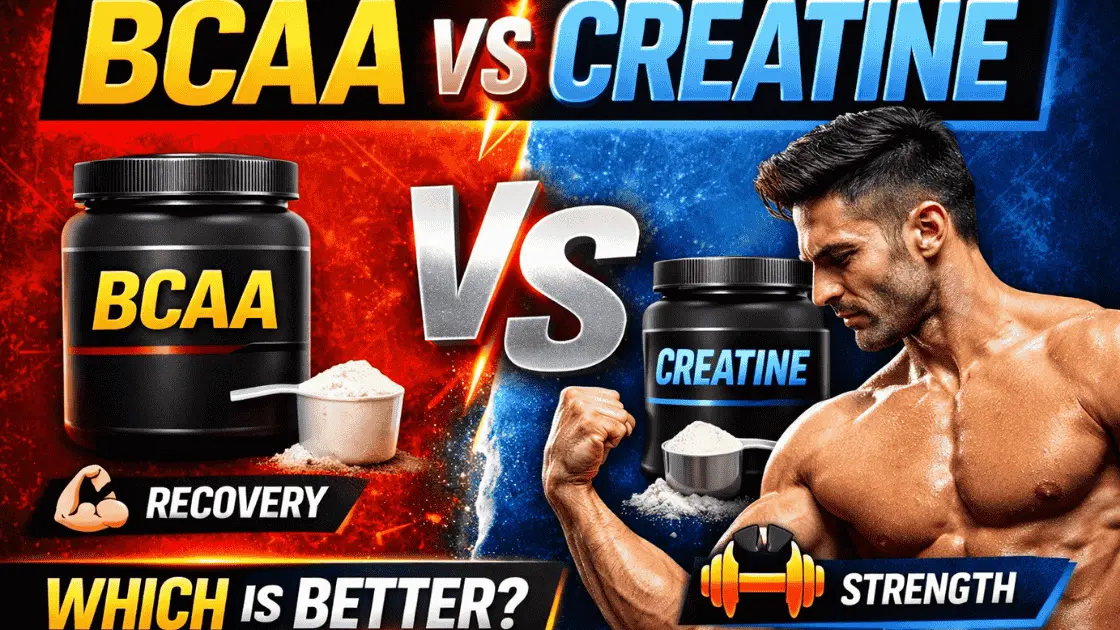
Creatine has stronger support for performance and training adaptation in many beginner contexts. BCAAs become far less compelling when total daily protein intake is already adequate.
That does not mean every beginner must use creatine. It means the comparison is not very close once the basics are in place.
How to get value from this guide in the first week
If you want the page to feel usable immediately, follow this order first.
Check the basics first
Use this page only after sleep, food, and training consistency are at least decent. A supplement should support a working routine, not rescue a broken one.
Judge it in training context
Use the sample week and anchor lifts like Bench Press to decide whether the supplement is affecting performance, recovery, digestion, or adherence in a noticeable way.
Review calmly, not emotionally
Give it a fair test period, then judge the result against clear signals. Keep it if it solves a real problem. Skip it if the benefit is still theoretical.
How I would set up the week in real life
Supplements do not build the body by themselves. The training block below shows where this topic actually intersects with performance, recovery, or adherence.
Use the following schedule as the practical context for judging whether the supplement is helping. If performance, recovery, or consistency do not change, the answer is usually not to buy more products.
| Day | Focus | Main session | Support work |
|---|---|---|---|
| Day 1 | Strength push | Bench press and shoulder press | Track performance with or without supplementation |
| Day 2 | Strength pull | Pulldown and row work | Normal protein-rich meals |
| Day 3 | Leg focus | Squat and deadlift pattern | Good carbs and hydration |
| Day 4 | Conditioning or recovery | Walk or intervals | See what actually improves |
Best fit for this plan
Use the points below to judge whether this supplement guide fits your current level, setup, and goal.
- You want to know whether BCAA or creatine deserves your money first.
- You are already training and eating reasonably well but want one practical supplement decision.
- You want a comparison grounded in how the products are actually used.
Exercise notes that matter in the moment
The movement library below keeps the page practical: Bench Press, Lat Pulldown, and Back Squat. Each entry includes the job of the exercise, setup details, common mistakes, smart substitutions, and local video demos.
Bench Press
This lift helps you judge whether the supplement conversation is affecting real performance. In the context of BCAA vs Creatine: Which Is Better for Beginners and Which One Can You Ignore?, this movement earns its place because it teaches repeatable effort instead of random fatigue.
Target muscles: Upper-body strength
Step-by-step instructions
- Set your feet first, squeeze the bench or floor with your upper back, and brace before the first rep.
- Lower the weight with control until your elbows stay stacked under your wrists instead of flaring wildly.
- Drive the handle or dumbbell up by pushing through the palm and keeping your ribcage quiet.
- Pause long enough at the top to reset your shoulder position before the next rep.
Common mistakes
- Letting the shoulders roll forward and turning the top half of the set into a shrug.
- Bouncing the weight or arching hard just to turn a moderate load into an ego rep.
Pro tips
- Film your first working set from the side once a week so you can see bar path and elbow position clearly.
Use roughly 3 sets of 5-8 for Bench Press in this supplement guide. The goal is repeatable quality, not squeezing out sloppy extras.
Home alternative: Push-up
Gym alternative: Machine press
Lat Pulldown
Pulldowns create a repeatable performance marker without overcomplicating the session. In the context of BCAA vs Creatine: Which Is Better for Beginners and Which One Can You Ignore?, this movement earns its place because it teaches repeatable effort instead of random fatigue.
Target muscles: Back and lats
Step-by-step instructions
- Set your torso angle first so your lower back feels stable and your chest stays proud.
- Start the pull by moving the shoulder blade, then bring the elbow toward the hip instead of yanking with the hand.
- Keep your neck long and avoid shrugging as the weight travels.
- Control the return fully so the target muscle stays loaded instead of the stack bouncing.
Common mistakes
- Leaning back so far that the torso, not the lats or upper back, moves the load.
- Cutting the return short and losing half of the training effect.
Pro tips
- Think elbow to hip on lats work and elbow out on upper-back work so the right tissue gets the stress.
A practical starting point for Lat Pulldown on this supplement guide is 3 sets of 10-12. End the set when speed or position starts to slip.
Home alternative: Band pulldown
Gym alternative: Assisted pull-up
Back Squat
Squats are one of the clearest places to judge whether recovery and performance support are actually improving. In the context of BCAA vs Creatine: Which Is Better for Beginners and Which One Can You Ignore?, this movement earns its place because it teaches repeatable effort instead of random fatigue.
Target muscles: Lower-body strength
Step-by-step instructions
- Plant the full foot, inhale into your midsection, and create tension before descending.
- Let the knees travel naturally while keeping pressure through the mid-foot instead of only the toes.
- Use a depth you can own with a neutral torso and stable hips.
- Stand up by driving the floor away, then reset the brace before repeating.
Common mistakes
- Rushing the descent so the knees and feet stop cooperating.
- Standing up with the chest collapsing and losing balance at the hardest point.
Pro tips
- Use your warm-up sets to find the foot stance that keeps the whole foot grounded before the work sets start.
For Back Squat, work in the 3 x 5-8 range here and leave a little technical margin so the last rep still looks like the first in this supplement guide.
Home alternative: Goblet squat
Gym alternative: Hack squat
Rowing Machine Sprint
Short power intervals give another way to feel whether training output is changing over time. In the context of BCAA vs Creatine: Which Is Better for Beginners and Which One Can You Ignore?, this movement earns its place because it teaches repeatable effort instead of random fatigue.
Target muscles: Work capacity and repeat power
Step-by-step instructions
- Set your torso angle first so your lower back feels stable and your chest stays proud.
- Start the pull by moving the shoulder blade, then bring the elbow toward the hip instead of yanking with the hand.
- Keep your neck long and avoid shrugging as the weight travels.
- Control the return fully so the target muscle stays loaded instead of the stack bouncing.
Common mistakes
- Leaning back so far that the torso, not the lats or upper back, moves the load.
- Cutting the return short and losing half of the training effect.
Pro tips
- Think elbow to hip on lats work and elbow out on upper-back work so the right tissue gets the stress.
Use roughly 5 sets of 20 sec for Rowing Machine Sprint in this supplement guide. The goal is repeatable quality, not squeezing out sloppy extras.
Home alternative: Fast band row intervals
Gym alternative: Assault bike sprint
Making the plan survive Indian routines, crowds, and missed days
Most beginner plans stop working because the support habits fall apart before the workouts do. This section keeps spend on the supplement that actually matches your training needs tied to real life.
If muscle gain is the goal, stop hunting for exotic foods first. A dependable mix of milk, curd, eggs, paneer, dal, rice, roti, soy, and fruit is still what keeps training performance moving.
Pre-workout
Use easy digestion before training: banana with curd, poha with peanuts, toast with eggs, fruit plus milk, or a lighter rice-and-dal meal if strength push lands later in the day.
Crowd-proof habit
Busy gym floors are part of the environment, not bad luck. Have a backup for the first movement and you will finish more useful sessions over the month.
What readers usually skip
- If protein intake is already adequate, BCAA often becomes low priority quickly.
- Do not buy both just because the label sounds more serious that way.
- Use performance logs and body weight trends instead of relying on subjective hype.
- Budget spent on better food often outperforms budget spent on extra powders.
When to pull back, when to push, and what to swap
Use these adjustments to keep Bench Press and the rest of the page effective whether you are coming in fresh or returning with a base around spend on the supplement that actually matches your training needs.
If you are newer than you think
Treat the plan like skill practice first. If Bench Press and the next key movement are improving, you do not need extra volume just to feel more serious about spend on the supplement that actually matches your training needs.
If you already have a base
Add one accessory movement, push the final working set slightly harder, and use the smallest sensible load jump. Progress usually comes from cleaner effort, not from doubling the exercise list when spend on the supplement that actually matches your training needs is the target.
| Main movement | Home-friendly option | Gym-friendly option |
|---|---|---|
| Bench Press | Push-up | Machine press |
| Lat Pulldown | Band pulldown | Assisted pull-up |
| Back Squat | Goblet squat | Hack squat |
| Rowing Machine Sprint | Fast band row intervals | Assault bike sprint |
A cleaner way to judge progress than soreness or scale panic
Use the four-week build below to make Bench Press and Lat Pulldown feel more repeatable before you worry about dramatic jumps.
Week 1: Build the groove
Week one is about finding a clean rhythm. Keep the loads tame, pay attention to setup on Bench Press, and leave the session knowing what next week should look like.
Week 2: Add useful work
Week two should feel slightly fuller, not dramatically harder. Add only the amount of work you can still recover from without making strength push messy.
Week 3: Push the main lifts a little
Use the smallest load jump available or slow the lowering phase on Bench Press. The page should feel more productive here, but it still should not look like panic training.
Week 4: Compare, then recycle
By week four, compare the same lifts honestly. If Bench Press and Lat Pulldown look steadier, the page is working even if progress feels less dramatic than social media promised.
Within a few training weeks, the better investment usually becomes clear. The answer depends less on branding and more on whether your basics were already in place before you spent the money.
FAQ for this page
These are the questions most likely to come up once you try to use the page in real life.
Should I use this supplement if my routine is still messy?
No. Fix training, meals, and sleep first. A supplement is easier to judge when the basics are already steady enough to show whether it is helping.
How do I know whether it is actually worth it?
Judge it against something real: performance on Bench Press, recovery, digestion, convenience, or consistency. If none of those improve, the product probably is not doing much for you.
Who should be more cautious with supplement advice?
Anyone with medical conditions, pregnancy, medication use, allergies, or persistent symptoms should make personal decisions with a qualified professional rather than relying on a general article.
Evidence and standards used here
These references support the coaching choices in BCAA vs Creatine: Which Is Better for Beginners and Which One Can You Ignore?. They are here to ground the page in published guidance and better evidence, not to replace individualized coaching or medical care.

Alok Kumar Sharma
Alok Kumar Sharma covers supplements for beginners who want honest trade-offs, not hype, fear marketing, or product-first advice while training in a supplement decision-making for gym beginners.
- Focus: Indian budget fitness, beginner gym systems, body recomposition, and sustainable muscle gain
- Training style: strength-first technique, simple tracking, and realistic progress over flashy challenge culture
- Typical lens: crowded commercial gyms, home-workout friction, hostel meals, office fatigue, and family-kitchen meal planning
- Every core guide is reviewed by Rahul Verma, Certified Fitness Trainer (ISSA) for exercise safety, setup, tempo, substitutions, and progression clarity