
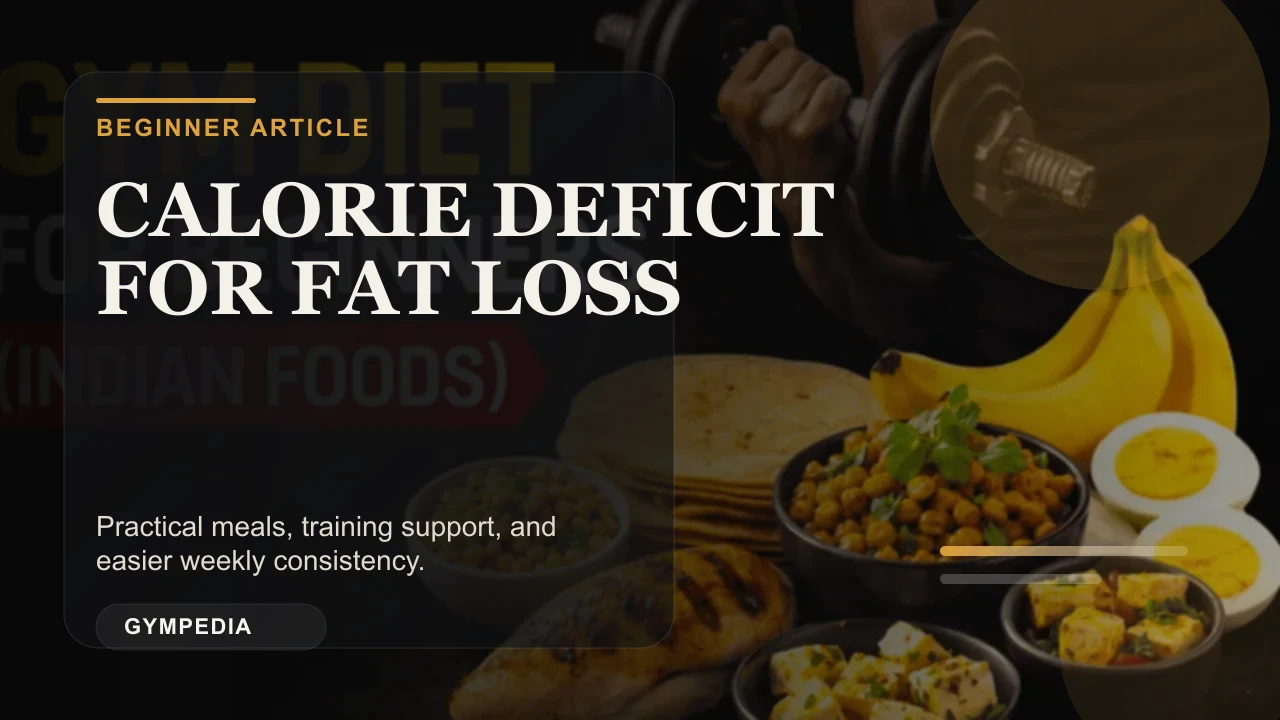
Why this nutrition guide feels more realistic in a busy week
This guide is about building a calorie deficit you can actually live with, so fat loss does not come at the cost of miserable hunger, weak training, or a chaotic routine.
A calorie deficit is simple in theory and messy in real life. That is why so many beginners understand the idea but still struggle to follow it once work stress, family meals, hunger, and random weekend eating show up.
This page turns the concept into something more usable. It shows you how to build a calorie deficit around repeatable meals, realistic activity, and training that protects muscle instead of making the cut feel harder than it needs to be.
If this sounds like your current situation
This guide fits best if your current goal is to build a calorie deficit that supports fat loss without wrecking training, hunger control, or daily life.
- You want to lose body fat but need a calorie deficit that feels sustainable in an Indian food environment.
- You are confused by online advice that makes fat loss sound like endless tracking math or extreme restriction.
- You want a clearer link between your diet, steps, and training plan.
How to use this page without overthinking it
Use these three steps to keep the page practical instead of letting it turn into another saved tab.
Start with one meal anchor
Pick one repeatable protein anchor first and attach it to strength training. That could be eggs, curd, paneer, dal, soy, milk, or another food you can actually buy and repeat.
Use the weekly layout, not random meals
Follow the sample week as a structure, not a prison. The goal is to make the food pattern easier to repeat, not to create seven perfect days on paper.
Track one useful response
Watch energy, digestion, hunger, and training performance. If those improve, the page is doing its job even before body-composition changes become obvious.
Session map and weekly rhythm
Nutrition advice becomes much more valuable when it is attached to a real training schedule. Use this block to connect your meals to repeatable work in the gym or at home.
Keep the training side basic while the food habits settle in. Simple lifting plus dependable meal timing usually beats an overbuilt plan.
| Day | Focus | Main session | Support work |
|---|---|---|---|
| Day 1 | Strength training | Full-body workout plus a normal protein-rich dinner | Do not reward the session with random overeating |
| Day 2 | Walking focus | Steps or incline walking | Keep lunch and dinner predictable |
| Day 3 | Recovery | Normal activity and hydration | Watch liquid calories and mindless snacking |
| Day 4 | Strength repeat | Repeat the core lifts and log performance | A good deficit should still let you train |
Execution cues for the movements that drive results
This page leans on the goblet squat, bench press, and incline walk because they cover strength, muscle retention, and energy output well for beginners. The notes below show how to keep each one useful.
Goblet Squat
Goblet squats give beginners a leg movement they can repeat with cleaner depth and less setup stress than a rushed barbell squat. In the context of Calorie Deficit for Fat Loss: A Beginner Guide That Is Easier to Follow, this movement earns its place because it teaches repeatable effort instead of random fatigue.
Target muscles: Quads, glutes, adductors, and trunk stiffness
Step-by-step instructions
- Plant the full foot, inhale into your midsection, and create tension before descending.
- Let the knees travel naturally while keeping pressure through the mid-foot instead of only the toes.
- Use a depth you can own with a neutral torso and stable hips.
- Stand up by driving the floor away, then reset the brace before repeating.
Common mistakes
- Rushing the descent so the knees and feet stop cooperating.
- Standing up with the chest collapsing and losing balance at the hardest point.
Pro tips
- Use your warm-up sets to find the foot stance that keeps the whole foot grounded before the work sets start.
Sets and reps for Goblet Squat in this nutrition guide: 3 sets of 8-12. Stop with 1-2 solid reps still in reserve unless the page says otherwise.
Home alternative: Bodyweight squat to a box or chair
Gym alternative: Front squat or hack squat
Bench Press
A horizontal press gives the full-body plan one reliable upper-body strength marker that is easy to track over several weeks. In the context of Calorie Deficit for Fat Loss: A Beginner Guide That Is Easier to Follow, this movement earns its place because it teaches repeatable effort instead of random fatigue.
Target muscles: Chest, front delts, triceps
Step-by-step instructions
- Set your feet first, squeeze the bench or floor with your upper back, and brace before the first rep.
- Lower the weight with control until your elbows stay stacked under your wrists instead of flaring wildly.
- Drive the handle or dumbbell up by pushing through the palm and keeping your ribcage quiet.
- Pause long enough at the top to reset your shoulder position before the next rep.
Common mistakes
- Letting the shoulders roll forward and turning the top half of the set into a shrug.
- Bouncing the weight or arching hard just to turn a moderate load into an ego rep.
Pro tips
- Film your first working set from the side once a week so you can see bar path and elbow position clearly.
A practical starting point for Bench Press on this nutrition guide is 3 sets of 6-8. End the set when speed or position starts to slip.
Home alternative: Push-up with feet or hands adjusted for difficulty
Gym alternative: Machine chest press
Incline Walk
Not every cardio session needs to be brutal. Incline walking is sustainable, recoverable, and highly useful for body-composition goals. In the context of Calorie Deficit for Fat Loss: A Beginner Guide That Is Easier to Follow, this movement earns its place because it teaches repeatable effort instead of random fatigue.
Target muscles: Aerobic base and fat-loss support
Step-by-step instructions
- Choose a pace or incline that lets you keep breathing controlled while still feeling like work.
- Keep posture tall and swing the arms naturally instead of hanging on the machine handles.
- Use stride length you can repeat without your hips rocking side to side.
- Finish with enough energy left that the next lifting or work day still feels normal.
Common mistakes
- Adding speed before you own the pattern.
- Letting the easiest body part compensate for the weakest one.
Pro tips
- Keep one rep in reserve on the first week so your technique stays sharp enough to build on next session.
Sets and reps for Incline Walk in this nutrition guide: 1 sets of 20-30 min. Stop with 1-2 solid reps still in reserve unless the page says otherwise.
Home alternative: Brisk outdoor walk
Gym alternative: Stairmill easy intervals
Mountain Climber
This movement blends heart-rate work with trunk tension, which is useful when you only have floor space. In the context of Calorie Deficit for Fat Loss: A Beginner Guide That Is Easier to Follow, this movement earns its place because it teaches repeatable effort instead of random fatigue.
Target muscles: Core, shoulders, hip flexors, conditioning
Step-by-step instructions
- Start with a pace you can repeat for the full interval instead of sprinting the first ten seconds.
- Keep the landing soft and the trunk braced so the movement stays athletic instead of chaotic.
- Breathe rhythmically and let the arms help create timing.
- Use the rest interval on purpose so the next round keeps quality, not just fatigue.
Common mistakes
- Adding speed before you own the pattern.
- Letting the easiest body part compensate for the weakest one.
Pro tips
- Keep one rep in reserve on the first week so your technique stays sharp enough to build on next session.
Sets and reps for Mountain Climber in this nutrition guide: 4 sets of 30 sec. Stop with 1-2 solid reps still in reserve unless the page says otherwise.
Home alternative: Elevated mountain climber
Gym alternative: Slider mountain climber
Glute Bridge
Bridges help beginners finally feel the glutes working without lower-back tension taking over the whole set. In the context of Calorie Deficit for Fat Loss: A Beginner Guide That Is Easier to Follow, this movement earns its place because it teaches repeatable effort instead of random fatigue.
Target muscles: Glutes and hamstrings
Step-by-step instructions
- Start by sending the hips back while keeping the shin angle quiet and the spine long.
- Feel the stretch through the hamstrings before you think about the load in your hands.
- Keep the bar, dumbbells, or torso close to the body as you reverse the movement.
- Finish tall by squeezing the glutes rather than leaning back.
Common mistakes
- Adding speed before you own the pattern.
- Letting the easiest body part compensate for the weakest one.
Pro tips
- Keep one rep in reserve on the first week so your technique stays sharp enough to build on next session.
Use roughly 3 sets of 10-15 for Glute Bridge in this nutrition guide. The goal is repeatable quality, not squeezing out sloppy extras.
Home alternative: Floor bridge with pause
Gym alternative: Barbell hip thrust
Plank
Plank work teaches bracing so the lifting patterns on the page feel stronger and cleaner instead of just more tiring. In the context of Calorie Deficit for Fat Loss: A Beginner Guide That Is Easier to Follow, this movement earns its place because it teaches repeatable effort instead of random fatigue.
Target muscles: Rectus abdominis, transverse abdominis, obliques
Step-by-step instructions
- Set your ribcage down and lightly tuck the pelvis so the abs do the work instead of the hip flexors alone.
- Move only through the range where your lower back stays quiet and controlled.
- Exhale through the hardest part to improve brace quality.
- Stop the set the moment the torso starts rocking or the neck takes over.
Common mistakes
- Holding tension in the neck and jaw instead of the trunk.
- Choosing a range that makes the lower back take over.
Pro tips
- Shorter, cleaner sets beat long sloppy sets when the goal is trunk control and visible progression.
Use roughly 2 sets of 30-45 sec for Plank in this nutrition guide. The goal is repeatable quality, not squeezing out sloppy extras.
Home alternative: Knee plank
Gym alternative: Weighted plank
Four-week checkpoint
Good progression should make Goblet Squat and Bench Press look steadier before it makes the page feel dramatically harder.
Week 1: Build the groove
Keep loads conservative, own the setup, and make the first session of strength training feel repeatable. This is the week to remove confusion, not to impress yourself.
Week 2: Add useful work
If week one looked stable, add a little work where it matters most: one small rep bump, one small load bump, or one extra set on the opening movements like Goblet Squat.
Week 3: Push the main lifts a little
Push one or two anchor lifts a little harder in week three. For most readers that means a careful load increase on Goblet Squat or a slower lowering phase, not extra random sets.
Week 4: Compare, then recycle
Check whether Goblet Squat and Bench Press look cleaner than week one. If they do, keep the block and rerun it with slightly better numbers or better control.
You may feel more in control of food within the first week. Visible fat-loss changes usually need 4-8 weeks or more depending on your starting point, adherence, and how moderate the deficit is.
How to make this fit a family kitchen, hostel, or office schedule
Most beginner plans stop working because the support habits fall apart before the workouts do. This section keeps build a calorie deficit that supports fat loss without wrecking training, hunger control, or daily life tied to real life.
To lean out without flattening training quality, build meals around satiety and routine: protein at each meal, easier carb control, and fewer random snack swings.
Pre-workout
Before training, think light and repeatable: curd with fruit, eggs on toast, poha, milk with a banana, or a smaller dal-rice meal that will not sit heavily before Goblet Squat.
Budget reality
Prepare the floor space, first exercise, and timer before motivation becomes the bottleneck. Home plans improve when startup friction gets cut aggressively around Goblet Squat.
What readers usually skip
- If family meals are fixed, control portion size and protein first instead of trying to redesign everyone else's food.
- A small planned snack is often better than pretending you can avoid hunger until late-night overeating starts.
- Track your body weight trend over two to three weeks, not a single morning after salty or restaurant-heavy days.
- When gym performance collapses, do not assume the deficit is working better. It may simply be too aggressive.
How to set up a calorie deficit without turning your whole day into food math
A nutrition guide is only useful if it still makes sense at the stove, in the office, or while ordering a simple meal.
Start with the easiest levers first: predictable meal timing, more protein, more vegetables, and a consistent step count. Those changes often create the structure a deficit needs before hard calorie tracking even starts.
Use a small deficit you can repeat. Most beginners do better when the diet still leaves enough energy for training, sleep, and normal social life.
A calorie deficit works better when the menu gets simpler, not when every meal becomes a different experiment.
The calorie deficit mistakes that make fat loss feel harder than it should
Cutting too hard
A huge deficit usually makes training, hunger, and adherence worse long before it makes results better.
Ignoring protein
Low protein turns a cut into a low-energy diet instead of a body-composition plan.
Underestimating weekend eating
Many good weekdays get erased by two unstructured days that feel harmless in the moment.
Common sticking points and how to adjust
Use the notes below to keep Goblet Squat productive whether your current level is brand new, rusty, or ready for a little more output in a indian home kitchen, hostel routine, or office schedule.
If you are newer than you think
Treat the plan like skill practice first. If Goblet Squat and the next key movement are improving, you do not need extra volume just to feel more serious about build a calorie deficit that supports fat loss without wrecking training, hunger control, or daily life.
If you already have a base
Add one accessory movement, push the final working set slightly harder, and use the smallest sensible load jump. Progress usually comes from cleaner effort, not from doubling the exercise list when build a calorie deficit that supports fat loss without wrecking training, hunger control, or daily life is the target.
| Main movement | Home-friendly option | Gym-friendly option |
|---|---|---|
| Goblet Squat | Bodyweight squat to a box or chair | Front squat or hack squat |
| Bench Press | Push-up with feet or hands adjusted for difficulty | Machine chest press |
| Incline Walk | Brisk outdoor walk | Stairmill easy intervals |
| Mountain Climber | Elevated mountain climber | Slider mountain climber |
| Glute Bridge | Floor bridge with pause | Barbell hip thrust |
| Plank | Knee plank | Weighted plank |
Quick answers before you leave this guide
Use these answers to clear the last bits of friction before you apply the plan.
Can I follow this if my meals are mostly home food or hostel food?
Yes. These nutrition pages are meant to work with normal Indian food patterns first. Use the structure, keep the protein anchors consistent, and adjust portions before you start inventing a separate diet life.
Do I need supplements for this page to work?
Usually no. The first win is getting food timing, protein, hydration, and repeatable shopping under control. Supplements are optional convenience tools, not the base of the plan.
What should I track in the first two weeks?
Track body-weight trend, gym performance, hunger, and digestion. If Goblet Squat is improving and meals feel easier to repeat, the page is already doing useful work.
References and review standards
These references support the coaching choices in Calorie Deficit for Fat Loss: A Beginner Guide That Is Easier to Follow. They are here to ground the page in published guidance and better evidence, not to replace individualized coaching or medical care.
Alok Kumar Sharma
Alok Kumar Sharma covers nutrition the way most Indian beginners actually live it: family meals, hostel mess food, office schedules, and budgets that do not leave room for unnecessary products when build a calorie deficit that supports fat loss without wrecking training, hunger control, or daily life is the goal.
- Focus: Indian budget fitness, beginner gym systems, body recomposition, and sustainable muscle gain
- Training style: strength-first technique, simple tracking, and realistic progress over flashy challenge culture
- Typical lens: crowded commercial gyms, home-workout friction, hostel meals, office fatigue, and family-kitchen meal planning
- Every core guide is reviewed by Rahul Verma, Certified Fitness Trainer (ISSA) for exercise safety, setup, tempo, substitutions, and progression clarity