
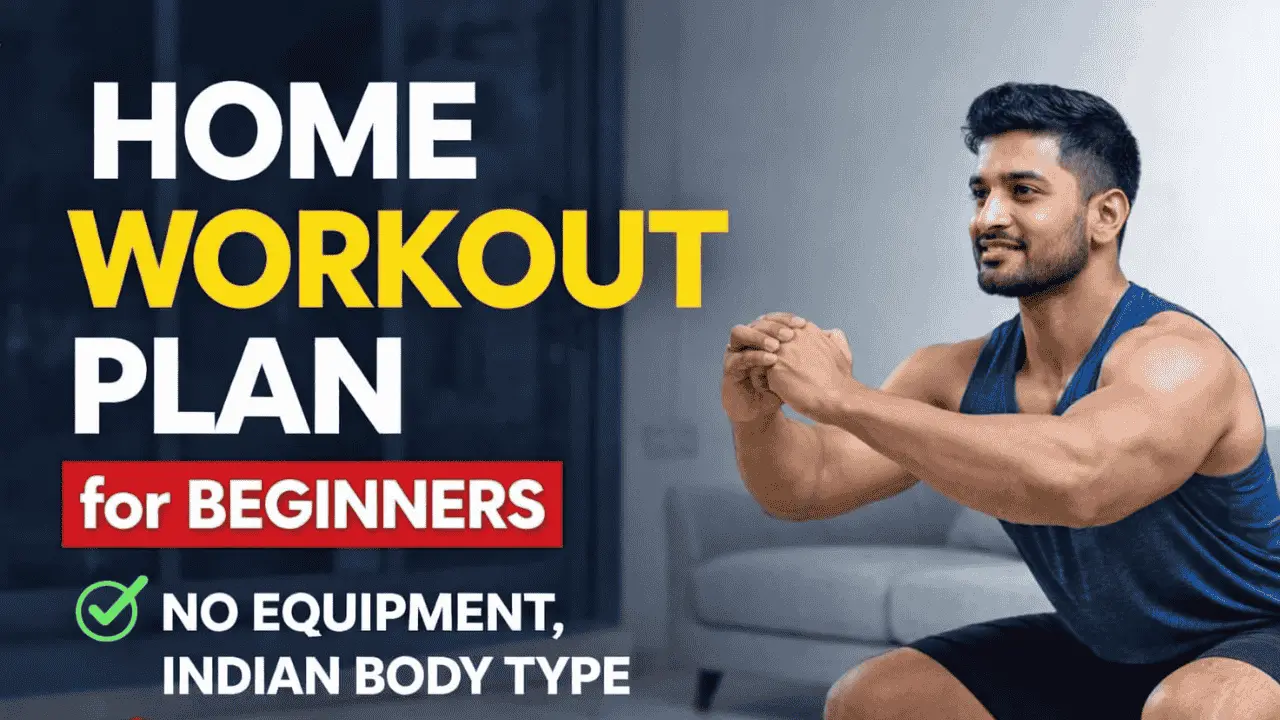
Why this fitness guide works better than a random saved reel
Use this guide if you want a strong beginner routine at home with no equipment and you need something realistic enough to survive low-energy days too.
No-equipment workouts become useless when they turn into random exhausting circuits that never progress. The fix is not more intensity. It is better structure, smarter exercise selection, and a weekly rhythm you can actually keep up while working, studying, or training from a small room.
This page gives you exactly that. It is a home plan built around bodyweight patterns that can progress through leverage, tempo, and cleaner reps before equipment is even part of the conversation.
How to use this guide on the very first session
If you only need one clean first session, begin with full body a and use Bodyweight Squat, Incline Push-Up, and Glute Bridge as the anchor.
Start with this
Run Bodyweight squat, incline push-up, glute bridge with controlled effort. Leave the session feeling like you could have done slightly more instead of turning day one into a recovery problem.
What to track
Log sets, reps, and one technique note on Bodyweight Squat. If that movement looks better next week, the page is doing its job.
Do not do this
Avoid turning day one into a test. Keep the plan compact, track the anchors, and save extra volume for later weeks.
Who gets the most from this fitness guide
Keep reading if you want a cleaner route to build a strong beginner routine at home with no equipment without chasing random fixes.
- You are training from a room, living space, or hostel without equipment.
- You want to get stronger and fitter before deciding whether a gym is even necessary.
- You need a home plan that respects noisy neighbors, limited space, and limited time.
How to make bodyweight work harder without adding tools
Bodyweight training progresses through cleaner range, slower tempo, harder leverage, less rest, and more total quality volume. That means you can keep improving for much longer than most beginners assume.
The main mistake is jumping straight to advanced variations before the basic pattern is stable. Use this plan to earn harder versions one layer at a time.
A home routine you can repeat without overthinking it
The schedule below is designed around 3-5 focused sessions a week with repeatable exercise selection. Start with full body a, repeat it for a few weeks, and let pattern quality on Bodyweight Squat become obvious before you chase novelty.
| Day | Focus | Main session | Support work |
|---|---|---|---|
| Day 1 | Full body A | Bodyweight squat, incline push-up, glute bridge | Bird dog and brisk walk |
| Day 2 | Recovery | Normal steps and mobility | Do not chase soreness |
| Day 3 | Full body B | Reverse lunge, plank, mountain climber | Easy stretching |
| Day 4 | Repeat A or conditioning | Choose the session you missed or need most | Keep it under 40 minutes |
Questions readers usually ask before the plan starts working
These are the real sticking points people run into before build a strong beginner routine at home with no equipment has had time to work.
Should I add more exercises?
Usually no. If Bodyweight Squat and the next two anchor movements are progressing, extra variety is more likely to distract than help.
What if equipment is busy?
Use the home and gym substitutions already listed instead of wandering around waiting for one machine to free up.
How hard should the sets feel?
Hard enough that the final reps need attention, not so hard that your form turns into a guess on every set.
Movement-by-movement coaching
The movement library below keeps the page practical: Bodyweight Squat, Incline Push-Up, and Glute Bridge. Each entry includes the job of the exercise, setup details, common mistakes, smart substitutions, and local video demos.
Bodyweight Squat
Squats are the easiest way to build lower-body confidence with zero equipment. In the context of Home Workout Plan for Beginners With No Equipment and No Need for Guesswork, this movement earns its place because it teaches repeatable effort instead of random fatigue.
Target muscles: Quads, glutes, coordination
Step-by-step instructions
- Plant the full foot, inhale into your midsection, and create tension before descending.
- Let the knees travel naturally while keeping pressure through the mid-foot instead of only the toes.
- Use a depth you can own with a neutral torso and stable hips.
- Stand up by driving the floor away, then reset the brace before repeating.
Common mistakes
- Rushing the descent so the knees and feet stop cooperating.
- Standing up with the chest collapsing and losing balance at the hardest point.
Pro tips
- Use your warm-up sets to find the foot stance that keeps the whole foot grounded before the work sets start.
For Bodyweight Squat, work in the 3 x 12-15 range here and leave a little technical margin so the last rep still looks like the first in this fitness guide.
Home alternative: Sit-to-stand from chair
Gym alternative: Goblet squat
Incline Push-Up
Incline push-ups let you learn proper pressing without getting trapped in ugly floor reps. In the context of Home Workout Plan for Beginners With No Equipment and No Need for Guesswork, this movement earns its place because it teaches repeatable effort instead of random fatigue.
Target muscles: Chest, shoulders, triceps
Step-by-step instructions
- Set your hands just outside shoulder width and lock the body into one straight line before the first rep.
- Lower under control until the chest gets close to the floor or bench without the hips sagging.
- Push the floor away while keeping the ribs tucked and the shoulders away from the ears.
- Reset the plank between reps so the final reps look like the first ones.
Common mistakes
- Letting the hips sag and turning the rep into a lower-back exercise.
- Shortening the range because the first rep was too hard from the chosen variation.
Pro tips
- Raise the hands on a bench or sturdy surface before you do ugly floor reps; cleaner volume builds faster progress.
Use roughly 3 sets of 8-12 for Incline Push-Up in this fitness guide. The goal is repeatable quality, not squeezing out sloppy extras.
Home alternative: Wall push-up
Gym alternative: Flat push-up or bench press
Glute Bridge
Bridges teach hip extension and help a lot of desk-bound beginners feel their glutes for the first time. In the context of Home Workout Plan for Beginners With No Equipment and No Need for Guesswork, this movement earns its place because it teaches repeatable effort instead of random fatigue.
Target muscles: Glutes and hamstrings
Step-by-step instructions
- Start by sending the hips back while keeping the shin angle quiet and the spine long.
- Feel the stretch through the hamstrings before you think about the load in your hands.
- Keep the bar, dumbbells, or torso close to the body as you reverse the movement.
- Finish tall by squeezing the glutes rather than leaning back.
Common mistakes
- Adding speed before you own the pattern.
- Letting the easiest body part compensate for the weakest one.
Pro tips
- Keep one rep in reserve on the first week so your technique stays sharp enough to build on next session.
For Glute Bridge, work in the 3 x 12-15 range here and leave a little technical margin so the last rep still looks like the first in this fitness guide.
Home alternative: Single-leg bridge
Gym alternative: Hip thrust
Reverse Lunge
Reverse lunges add single-leg strength without needing much space. In the context of Home Workout Plan for Beginners With No Equipment and No Need for Guesswork, this movement earns its place because it teaches repeatable effort instead of random fatigue.
Target muscles: Quads, glutes, balance
Step-by-step instructions
- Plant the full foot, inhale into your midsection, and create tension before descending.
- Let the knees travel naturally while keeping pressure through the mid-foot instead of only the toes.
- Use a depth you can own with a neutral torso and stable hips.
- Stand up by driving the floor away, then reset the brace before repeating.
Common mistakes
- Rushing the descent so the knees and feet stop cooperating.
- Standing up with the chest collapsing and losing balance at the hardest point.
Pro tips
- Use your warm-up sets to find the foot stance that keeps the whole foot grounded before the work sets start.
A practical starting point for Reverse Lunge on this fitness guide is 2 sets of 8-10 per side. End the set when speed or position starts to slip.
Home alternative: Static split squat
Gym alternative: Dumbbell reverse lunge
Mountain Climber
This movement increases challenge without needing impact-heavy jumps if space is limited. In the context of Home Workout Plan for Beginners With No Equipment and No Need for Guesswork, this movement earns its place because it teaches repeatable effort instead of random fatigue.
Target muscles: Core and conditioning
Step-by-step instructions
- Start with a pace you can repeat for the full interval instead of sprinting the first ten seconds.
- Keep the landing soft and the trunk braced so the movement stays athletic instead of chaotic.
- Breathe rhythmically and let the arms help create timing.
- Use the rest interval on purpose so the next round keeps quality, not just fatigue.
Common mistakes
- Adding speed before you own the pattern.
- Letting the easiest body part compensate for the weakest one.
Pro tips
- Keep one rep in reserve on the first week so your technique stays sharp enough to build on next session.
A practical starting point for Mountain Climber on this fitness guide is 3 sets of 20-30 sec. End the set when speed or position starts to slip.
Home alternative: Elevated mountain climber
Gym alternative: Slider climber
Plank
Planks keep the plan grounded in posture and brace quality rather than chaos. In the context of Home Workout Plan for Beginners With No Equipment and No Need for Guesswork, this movement earns its place because it teaches repeatable effort instead of random fatigue.
Target muscles: Core and posture
Step-by-step instructions
- Set your ribcage down and lightly tuck the pelvis so the abs do the work instead of the hip flexors alone.
- Move only through the range where your lower back stays quiet and controlled.
- Exhale through the hardest part to improve brace quality.
- Stop the set the moment the torso starts rocking or the neck takes over.
Common mistakes
- Holding tension in the neck and jaw instead of the trunk.
- Choosing a range that makes the lower back take over.
Pro tips
- Shorter, cleaner sets beat long sloppy sets when the goal is trunk control and visible progression.
For Plank, work in the 2 x 30-40 sec range here and leave a little technical margin so the last rep still looks like the first in this fitness guide.
Home alternative: Knee plank
Gym alternative: Weighted plank
How to scale the plan without losing the point
Use the notes below to keep Bodyweight Squat productive whether your current level is brand new, rusty, or ready for a little more output in a beginner gym routine or hybrid home setup.
If you are newer than you think
Keep the page smaller than your motivation. Use the main lifts, leave a little in reserve, and make your setup on Bodyweight Squat look the same every time before adding more total work toward build a strong beginner routine at home with no equipment.
If you already have a base
If recovery is solid, add one focused accessory or slow the lowering phase on the final main set. Keep the routine recognizable so progress comes from better execution, not from constant rewrites.
| Main movement | Home-friendly option | Gym-friendly option |
|---|---|---|
| Bodyweight Squat | Sit-to-stand from chair | Goblet squat |
| Incline Push-Up | Wall push-up | Flat push-up or bench press |
| Glute Bridge | Single-leg bridge | Hip thrust |
| Reverse Lunge | Static split squat | Dumbbell reverse lunge |
| Mountain Climber | Elevated mountain climber | Slider climber |
| Plank | Knee plank | Weighted plank |
Food, recovery, and real-life fixes that keep the plan usable
Training only sticks when the meals, timing, and recovery habits are realistic enough to repeat next week too, especially when build a strong beginner routine at home with no equipment is the target.
The food side only needs to do one thing well here: make full body a start with more energy and less guesswork.
Pre-workout
Before training, think light and repeatable: curd with fruit, eggs on toast, poha, milk with a banana, or a smaller dal-rice meal that will not sit heavily before Bodyweight Squat.
Schedule fix
At home, setup discipline matters more than hype. Put Bodyweight Squat in front of you before the session starts or the workout will keep getting delayed.
What readers usually skip
- Set a training corner and keep the first exercise visible on your phone or notebook before the session starts.
- Progress one thing at a time: reps, tempo, or rest time.
- If neighbors are a problem, replace jumps with step-ups, climbers, or brisk stair walking.
- Home workouts grow better when they stay small enough to repeat four times a week.
What to do when real life makes the ideal plan impossible
The plan is more valuable when it still works inside a home setup while you work on build a strong beginner routine at home with no equipment.
Home sessions usually fail because the room is open but the start ritual is weak. Lay out Bodyweight Squat before you begin and keep the session capped so build a strong beginner routine at home with no equipment still feels startable on low-motivation days.
If space is tight, prioritize the first three movements and treat the rest as optional support work instead of skipping the day entirely while you work on build a strong beginner routine at home with no equipment.
What your first month should honestly look like
Use the four-week build below to make Bodyweight Squat and Incline Push-Up feel more repeatable before you worry about dramatic jumps.
Week 1: Build the groove
Week one is about finding a clean rhythm. Keep the loads tame, pay attention to setup on Bodyweight Squat, and leave the session knowing what next week should look like.
Week 2: Add useful work
Week two should feel slightly fuller, not dramatically harder. Add only the amount of work you can still recover from without making full body a messy.
Week 3: Push the main lifts a little
Use the smallest load jump available or slow the lowering phase on Bodyweight Squat. The page should feel more productive here, but it still should not look like panic training.
Week 4: Compare, then recycle
By week four, compare the same lifts honestly. If Bodyweight Squat and Incline Push-Up look steadier, the page is working even if progress feels less dramatic than social media promised.
You can feel fitter in one to two weeks if sessions are consistent. Strength progress shows up quickly through better control and more reps, while visible body changes still follow months of training and food consistency.
Quick answers before you leave this guide
This FAQ is here to handle the practical doubts that usually show up after the first read.
Do I need every exercise listed on this page?
No. The first one or two anchor movements matter most. Use the substitutions when your setup demands it and keep the training intent intact instead of forcing one exact version.
How many times a week should I use this guide?
Use it at the frequency suggested in the weekly layout and let Bodyweight Squat tell you whether recovery is keeping up. If the first movement keeps getting sloppier, simplify before you add more volume.
When should I progress the plan?
Progress when the current version looks cleaner and more repeatable, not just when you feel impatient. Small rep bumps, cleaner tempo, or one extra set usually beat a dramatic rewrite.
Sources behind the coaching calls in this guide
These references support the coaching choices in Home Workout Plan for Beginners With No Equipment and No Need for Guesswork. They are here to ground the page in published guidance and better evidence, not to replace individualized coaching or medical care.
Alok Kumar Sharma
Alok Kumar Sharma writes these workout guides from the perspective of a regular gym-goer who learned more from fixing inconsistency than from chasing perfect phases on the way to build a strong beginner routine at home with no equipment.
- Focus: Indian budget fitness, beginner gym systems, body recomposition, and sustainable muscle gain
- Training style: strength-first technique, simple tracking, and realistic progress over flashy challenge culture
- Typical lens: crowded commercial gyms, home-workout friction, hostel meals, office fatigue, and family-kitchen meal planning
- Every core guide is reviewed by Rahul Verma, Certified Fitness Trainer (ISSA) for exercise safety, setup, tempo, substitutions, and progression clarity