
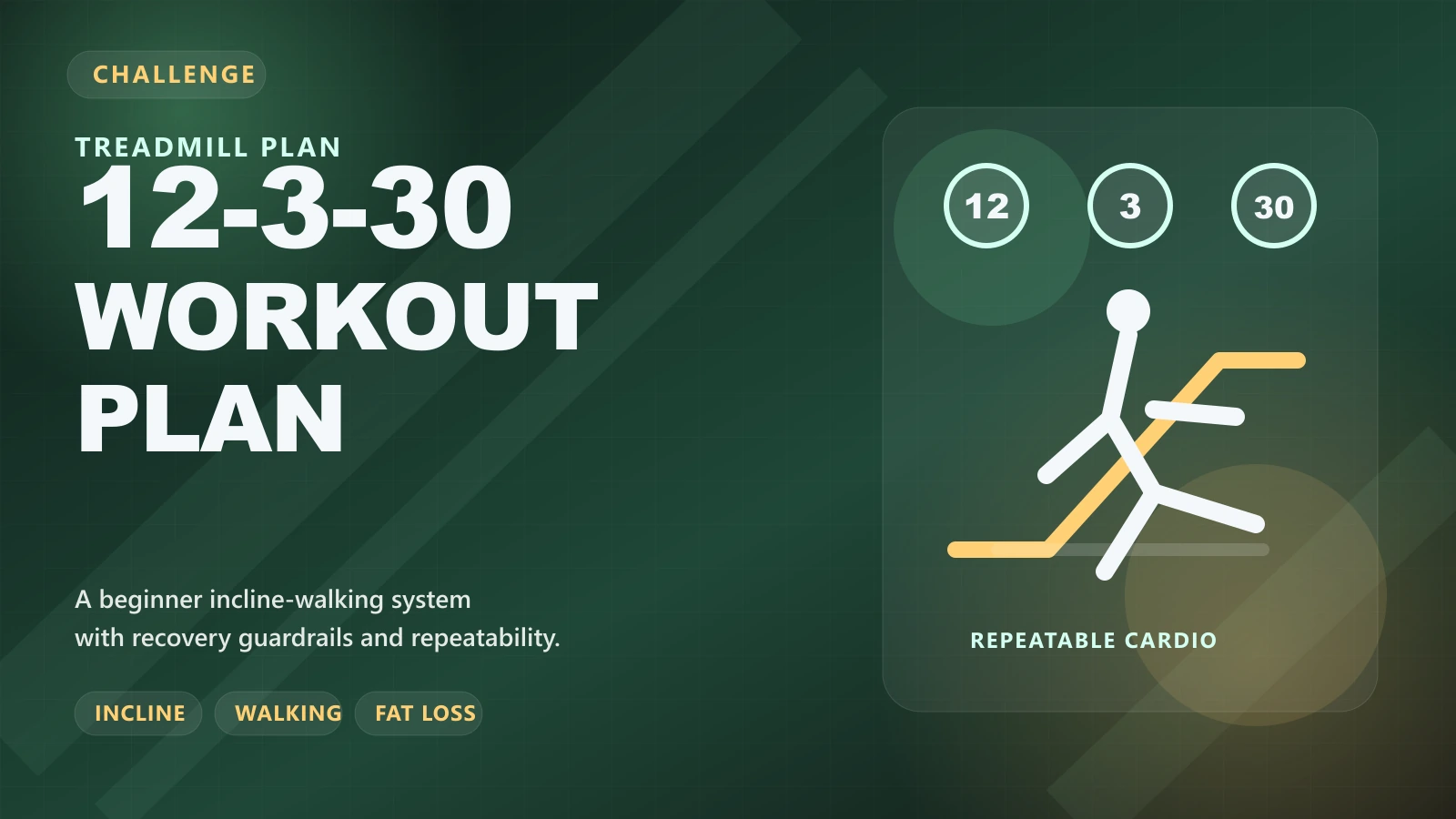
Before you start chasing harder variations
Use this guide when schedule drift, crowded spaces, or uneven meals matter more than chasing the perfect plan on paper for use the 12-3-30 workout as a repeatable fat-loss and fitness tool instead of daily punishment.
The reason the 12-3-30 workout exploded is easy to understand. It sounds simple, it feels measurable, and it gives beginners a treadmill routine that looks more structured than random walking. The problem is that many people jump straight into doing 12 incline, 3 speed, and 30 minutes every day, then assume the plan is failing when calves, feet, or motivation start complaining.
This version keeps the useful part and removes the reckless part. I treat the 12-3-30 treadmill workout as a cardio anchor, not a full transformation system. That means you still get the low-impact cardio, the walking workout for fat loss, and the easy-to-track treadmill routine for beginners, but you also get progression rules, supportive strength work, and a better answer to the question of whether 12-3-30 should happen before or after weights.
How to work through this page step by step
This section is here to make the guide easier to apply the same day you read it.
Run the block in order
Treat build the base as the starting anchor and keep the challenge sequence intact. These pages work better as short blocks than as random individual days.
Do not punish missed days
If you miss a day, resume the schedule instead of doubling the next session. A challenge only has value if it keeps momentum alive.
Judge completion, not drama
Track sessions finished, movement quality, energy, and consistency. That tells you more than whether every day felt intense enough for social media.
The rules that keep a 12-3-30 workout plan useful instead of obsessive
Start below the full prescription if you need to. A 6-10 incline at a controllable walking speed is still a legitimate entry point when your calves, feet, or aerobic base are not ready for the headline version.
Use 12-3-30 two to four times a week at first, not automatically every day. Most beginners do better when walking volume, lifting, and recovery all coexist instead of fighting each other.
Track repeatability more than calories burned. A 12-3-30 calories-burned estimate changes with body size, pace control, and treadmill calibration, but a plan you can actually repeat for a month is always more valuable than one dramatic session.
What the 12-3-30 workout does well and where people misuse it
Why it works
The incline makes walking feel more productive than a flat treadmill stroll, which is why the 12-3-30 walking workout can help beginners stay engaged.
Where it stalls
It stops feeling beginner-friendly when people force the full settings too early, hold the rails, or try to use 12-3-30 every day while also lifting hard.
What to measure
Notice breathing control, calf fatigue, recovery, weekly adherence, and whether the treadmill routine still feels startable after work or on low-motivation days.
Should you do 12-3-30 before or after weights?
If strength quality matters on the same day, lift first and use the 12-3-30 workout after weights or on a separate day. That keeps your squats, presses, and hinges sharper.
If the treadmill session is the main event and lifting is light support work, it is fine to walk first, then use two or three short strength movements later.
The right order is the one that protects the main goal of the day. For most fat-loss beginners, a split that includes both incline walking and simple strength work beats arguing over a perfect sequence.
Use this page if these realities apply to you
Use the points below to judge whether this challenge block fits your current level, setup, and goal.
- You want a beginner treadmill workout that feels more purposeful than flat walking but less punishing than running intervals.
- You are curious whether 12-3-30 for weight loss is worth doing and how to fit it into a realistic weekly plan.
- You want an incline treadmill workout that supports consistency, energy, and recovery instead of becoming a streak contest.
The weekly structure that keeps momentum steady
A useful challenge gives you rhythm, not chaos. Keep the sequence intact, respect the recovery days, and let consistency do the work.
| Day | Focus | Main session | Support work |
|---|---|---|---|
| Week 1 | Build the base | Use an easier incline or shorter duration if needed and finish two quality treadmill sessions | Add calf mobility and note how your feet feel |
| Week 2 | Own the full rhythm | Move toward the full 12-3-30 treadmill workout on two to three days | Pair it with goblet squats and glute bridges |
| Week 3 | Add useful volume | Keep two anchor walks and one optional shorter incline treadmill workout | Do not stack daily fatigue just because motivation is high |
| Week 4 | Retest the repeatable version | Compare breathing, pace control, and recovery versus week one | Choose the version you can sustain for the next month |
Form notes and practical exercise details
If you only remember a few movements from this page, make them 12-3-30 Treadmill Walk, Glute Bridge, and Goblet Squat. The breakdown below focuses on what each one is doing, what usually goes wrong, and how to keep the form honest.
12-3-30 Treadmill Walk
The incline walk is the anchor of the page because it gives beginners a structured treadmill routine that is lower impact than running. In the context of 12-3-30 Workout Plan for Beginners Who Want Fat Loss Without Daily Punishment, this movement earns its place because it teaches repeatable effort instead of random fatigue.
Target muscles: Aerobic base, calves, glutes, and work capacity
Step-by-step instructions
- Choose a pace or incline that lets you keep breathing controlled while still feeling like work.
- Keep posture tall and swing the arms naturally instead of hanging on the machine handles.
- Use stride length you can repeat without your hips rocking side to side.
- Finish with enough energy left that the next lifting or work day still feels normal.
Common mistakes
- Adding speed before you own the pattern.
- Letting the easiest body part compensate for the weakest one.
Pro tips
- Keep one rep in reserve on the first week so your technique stays sharp enough to build on next session.
Sets and reps for 12-3-30 Treadmill Walk in this challenge block: 1 sets of 20-30 min. Stop with 1-2 solid reps still in reserve unless the page says otherwise.
Home alternative: Outdoor hill walk or brisk walk
Gym alternative: Stairmill easy interval block
Glute Bridge
Bridges help beginners finally feel the glutes working without lower-back tension taking over the whole set. In the context of 12-3-30 Workout Plan for Beginners Who Want Fat Loss Without Daily Punishment, this movement earns its place because it teaches repeatable effort instead of random fatigue.
Target muscles: Glutes and hamstrings
Step-by-step instructions
- Start by sending the hips back while keeping the shin angle quiet and the spine long.
- Feel the stretch through the hamstrings before you think about the load in your hands.
- Keep the bar, dumbbells, or torso close to the body as you reverse the movement.
- Finish tall by squeezing the glutes rather than leaning back.
Common mistakes
- Adding speed before you own the pattern.
- Letting the easiest body part compensate for the weakest one.
Pro tips
- Keep one rep in reserve on the first week so your technique stays sharp enough to build on next session.
Sets and reps for Glute Bridge in this challenge block: 3 sets of 10-15. Stop with 1-2 solid reps still in reserve unless the page says otherwise.
Home alternative: Floor bridge with pause
Gym alternative: Barbell hip thrust
Goblet Squat
Goblet squats give beginners a leg movement they can repeat with cleaner depth and less setup stress than a rushed barbell squat. In the context of 12-3-30 Workout Plan for Beginners Who Want Fat Loss Without Daily Punishment, this movement earns its place because it teaches repeatable effort instead of random fatigue.
Target muscles: Quads, glutes, adductors, and trunk stiffness
Step-by-step instructions
- Plant the full foot, inhale into your midsection, and create tension before descending.
- Let the knees travel naturally while keeping pressure through the mid-foot instead of only the toes.
- Use a depth you can own with a neutral torso and stable hips.
- Stand up by driving the floor away, then reset the brace before repeating.
Common mistakes
- Rushing the descent so the knees and feet stop cooperating.
- Standing up with the chest collapsing and losing balance at the hardest point.
Pro tips
- Use your warm-up sets to find the foot stance that keeps the whole foot grounded before the work sets start.
For Goblet Squat, work in the 3 x 8-12 range here and leave a little technical margin so the last rep still looks like the first in this challenge block.
Home alternative: Bodyweight squat to a box or chair
Gym alternative: Front squat or hack squat
Split Squat
Single-leg work keeps the 12-3-30 workout from becoming only repetitive treadmill stress and helps build stronger walking mechanics. In the context of 12-3-30 Workout Plan for Beginners Who Want Fat Loss Without Daily Punishment, this movement earns its place because it teaches repeatable effort instead of random fatigue.
Target muscles: Quads, glutes, balance, and knee control
Step-by-step instructions
- Plant the full foot, inhale into your midsection, and create tension before descending.
- Let the knees travel naturally while keeping pressure through the mid-foot instead of only the toes.
- Use a depth you can own with a neutral torso and stable hips.
- Stand up by driving the floor away, then reset the brace before repeating.
Common mistakes
- Rushing the descent so the knees and feet stop cooperating.
- Standing up with the chest collapsing and losing balance at the hardest point.
Pro tips
- Use your warm-up sets to find the foot stance that keeps the whole foot grounded before the work sets start.
Sets and reps for Split Squat in this challenge block: 2 sets of 8-10 per side. Stop with 1-2 solid reps still in reserve unless the page says otherwise.
Home alternative: Supported split squat
Gym alternative: Smith-machine split squat
Standing Calf Raise
Calf work improves ankle resilience and rounds out lower-body development instead of leaving the lower leg ignored. In the context of 12-3-30 Workout Plan for Beginners Who Want Fat Loss Without Daily Punishment, this movement earns its place because it teaches repeatable effort instead of random fatigue.
Target muscles: Gastrocnemius and soleus
Step-by-step instructions
- Set the ball of the foot on the edge or platform and let the heel drop only as far as the ankle stays comfortable.
- Push straight through the big toe and second toe instead of rolling the ankle outward.
- Pause at the top for a full calf squeeze before lowering again.
- Keep the knee angle consistent so the calf does the work instead of bouncing through the rep.
Common mistakes
- Bouncing off the bottom with the Achilles instead of making the calf work through the whole range.
- Rushing the top so every rep becomes half a rep.
Pro tips
- Count a full second at both the top and bottom if calves normally feel like they only bounce, not contract.
Sets and reps for Standing Calf Raise in this challenge block: 3 sets of 12-15. Stop with 1-2 solid reps still in reserve unless the page says otherwise.
Home alternative: Single-leg calf raise on a step
Gym alternative: Sled calf press
Plank
Plank work teaches bracing so the lifting patterns on the page feel stronger and cleaner instead of just more tiring. In the context of 12-3-30 Workout Plan for Beginners Who Want Fat Loss Without Daily Punishment, this movement earns its place because it teaches repeatable effort instead of random fatigue.
Target muscles: Rectus abdominis, transverse abdominis, obliques
Step-by-step instructions
- Set your ribcage down and lightly tuck the pelvis so the abs do the work instead of the hip flexors alone.
- Move only through the range where your lower back stays quiet and controlled.
- Exhale through the hardest part to improve brace quality.
- Stop the set the moment the torso starts rocking or the neck takes over.
Common mistakes
- Holding tension in the neck and jaw instead of the trunk.
- Choosing a range that makes the lower back take over.
Pro tips
- Shorter, cleaner sets beat long sloppy sets when the goal is trunk control and visible progression.
A practical starting point for Plank on this challenge block is 2 sets of 30-45 sec. End the set when speed or position starts to slip.
Home alternative: Knee plank
Gym alternative: Weighted plank
Schedule, food, and consistency notes
Training only sticks when the meals, timing, and recovery habits are realistic enough to repeat next week too, especially when use the 12-3-30 workout as a repeatable fat-loss and fitness tool instead of daily punishment is the target.
To lean out without flattening training quality, build meals around satiety and routine: protein at each meal, easier carb control, and fewer random snack swings.
Pre-workout
Your pre-workout meal does not need to be fancy. Something easy to digest with a little protein and carbs is enough if it helps build the base start on time.
Consistency move
If work or family timing shifts, keep the anchor session and trim accessories first. The plan only needs to survive real life, not ideal conditions.
What readers usually skip
- Do not lean on the treadmill rails unless balance truly requires it. Holding on changes the work and usually makes the incline look harder than it really is.
- If your treadmill does not reach 12 incline, use the highest incline you can control with good posture and keep the session honest.
- A low-impact cardio plan works best when shoes, hydration, and calf recovery are treated like part of the program instead of afterthoughts.
- If 30 minutes feels impossible at first, build from 15-20 minutes and earn the full session with repeatability.
How progress usually unfolds when the basics are working
Use the four-week build below to make 12-3-30 Treadmill Walk and Glute Bridge feel more repeatable before you worry about dramatic jumps.
Week 1: Build the groove
Start with cleaner reps, calmer pacing, and enough restraint that the second exposure still feels useful. The point is to build rhythm around build the base, not to win the week.
Week 2: Add useful work
Add a small rep increase or one extra set on the first one or two movements if form stays sharp, especially around 12-3-30 Treadmill Walk. If recovery is bad, keep volume steady and improve execution instead of forcing use the 12-3-30 workout as a repeatable fat-loss and fitness tool instead of daily punishment.
Week 3: Push the main lifts a little
This is the week to make 12-3-30 Treadmill Walk feel more serious without turning the session chaotic. Small load jumps or cleaner tempo usually beat a dramatic rewrite when the goal is use the 12-3-30 workout as a repeatable fat-loss and fitness tool instead of daily punishment.
Week 4: Compare, then recycle
Use the fourth week as a checkpoint, not a finish line. If the anchor lifts in build the base are cleaner and recovery is manageable, recycle the structure and keep building from there.
Within two to four weeks, most beginners notice better breathing control, steadier treadmill pacing, and a clearer sense of how the 12-3-30 workout fits with lifting and fat-loss goals. Body-composition changes still depend on the whole week of movement and food, not only one cardio trend.
Beginner-to-intermediate adjustments
Use these adjustments to keep 12-3-30 Treadmill Walk and the rest of the page effective whether you are coming in fresh or returning with a base around use the 12-3-30 workout as a repeatable fat-loss and fitness tool instead of daily punishment.
If you are newer than you think
Keep the page smaller than your motivation. Use the main lifts, leave a little in reserve, and make your setup on 12-3-30 Treadmill Walk look the same every time before adding more total work toward use the 12-3-30 workout as a repeatable fat-loss and fitness tool instead of daily punishment.
If you already have a base
If you already recover well, add one focused accessory and make the final main set work harder. The upgrade is better output on the same skeleton, not a totally different plan for use the 12-3-30 workout as a repeatable fat-loss and fitness tool instead of daily punishment.
| Main movement | Home-friendly option | Gym-friendly option |
|---|---|---|
| 12-3-30 Treadmill Walk | Outdoor hill walk or brisk walk | Stairmill easy interval block |
| Glute Bridge | Floor bridge with pause | Barbell hip thrust |
| Goblet Squat | Bodyweight squat to a box or chair | Front squat or hack squat |
| Split Squat | Supported split squat | Smith-machine split squat |
| Standing Calf Raise | Single-leg calf raise on a step | Sled calf press |
| Plank | Knee plank | Weighted plank |
Frequently asked questions
These are the questions most likely to come up once you try to use the page in real life.
Can beginners do the 12-3-30 workout every day?
Usually no. Most beginners recover better with two to four incline sessions per week plus simple strength work. Doing it daily too soon often turns calf soreness and dread into the main result.
What if my treadmill does not reach 12 incline or 3 speed?
Use the closest settings you can control with upright posture and steady breathing. The better rule is repeatable incline walking, not worshipping one exact console number.
Is the 12-3-30 workout enough for fat loss on its own?
It can help create activity and consistency, but fat loss still depends on your total weekly movement, food intake, sleep, and whether the plan is repeatable for more than a few days.
Should I do 12-3-30 before or after weights?
If lifting quality matters most that day, do weights first and use the treadmill after. If the walk is the main goal and lifting is only support work, you can reverse the order.
Trusted sources for this page
These references support the coaching choices in 12-3-30 Workout Plan for Beginners Who Want Fat Loss Without Daily Punishment. They are here to ground the page in published guidance and better evidence, not to replace individualized coaching or medical care.
Alok Kumar Sharma
Alok Kumar Sharma treats challenge pages as short training blocks, not transformation promises: clear daily anchors, sensible progression, and recovery that keeps build the base usable.
- Focus: Indian budget fitness, beginner gym systems, body recomposition, and sustainable muscle gain
- Training style: strength-first technique, simple tracking, and realistic progress over flashy challenge culture
- Typical lens: crowded commercial gyms, home-workout friction, hostel meals, office fatigue, and family-kitchen meal planning
- Every core guide is reviewed by Rahul Verma, Certified Fitness Trainer (ISSA) for exercise safety, setup, tempo, substitutions, and progression clarity